




In today’s digital world, businesses generate massive amounts of data every day. From website visits and social media engagement to customer purchases and email campaigns, every interaction creates valuable information.
However, collecting data alone is not enough. The real advantage comes from understanding and using that data effectively.
This is where marketing analytics plays a crucial role. It helps businesses track performance, understand customer behavior, and make data-driven decisions that improve marketing results and increase revenue.
Marketing analytics is the process of measuring, managing, and analyzing marketing performance to maximize effectiveness and optimize return on investment (ROI).
By using marketing analytics, businesses can:
Instead of relying on assumptions, companies can use real data to understand what works and what needs improvement.
Modern consumers interact with businesses across multiple platforms. Without analytics, it becomes difficult to understand which marketing efforts are delivering results.
Analytics provides accurate insights that help businesses make smarter decisions based on facts rather than guesswork.
Businesses can learn about customer preferences, demographics, interests, and buying behavior.
Marketing analytics helps identify high-performing campaigns and eliminate ineffective strategies.
Understanding customer journeys allows businesses to create personalized experiences that improve satisfaction and loyalty.
Data-driven marketing strategies often lead to higher conversions, better retention, and increased sales.
Tracking the right metrics is critical for success.
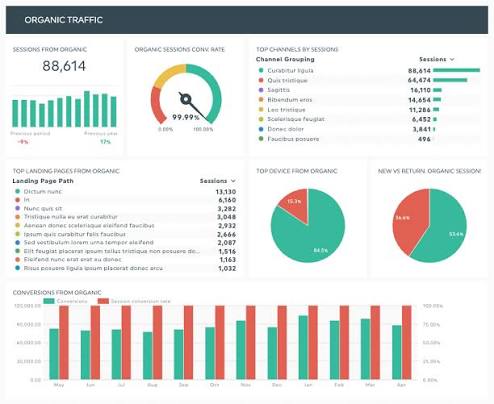
Shows how many visitors are coming to your site and where they are coming from.
Measures the percentage of visitors who complete a desired action.
Measures how much it costs to acquire a new customer.
Helps businesses understand whether their marketing campaigns are profitable.
Estimates the total revenue expected from a customer throughout the relationship.
Several tools help businesses collect and analyze marketing data.
Provides insights into website traffic, audience behavior, and conversion tracking.
Helps monitor website visibility in search engines and identify SEO opportunities.
Combines CRM, marketing automation, reporting, and analytics in one platform.
Offers keyword research, competitor analysis, backlink monitoring, and SEO reporting.
Widely used for SEO analytics, backlink analysis, and content performance tracking.
Marketing analytics and SEO work together to increase your website’s visibility, attract qualified visitors, and improve conversions through data-driven optimization.
Businesses that continuously monitor SEO analytics can identify opportunities faster, improve rankings, and generate more qualified leads over time.